A case study, 2025–2026: an independent analysis by Business Ingenuity, based on public information
At a glance
AI was only one of the forces that moved the world's most valuable technology companies between 2025 and October 2026. Trade shocks, a war, supply shortages and leadership changes tested their stability at least as much. Terms from Natural Synergy appear in italics and are defined in the Appendix.
| Subject | The Magnificent Seven: Alphabet, Amazon, Apple, Meta, Microsoft, Nvidia, Tesla |
| Period | Circa 2025 to October 2026 |
| Method | Independent analysis of public information, using the Natural Synergy framework |
| Baseline | Each company's 2025 operating state, as published in Chapter 1 of Natural Synergy |
| Headline finding | AI amplified each company's existing balance or imbalance. Non-AI shocks decided who stayed stable. |
The question
In Natural Synergy (2026), Ray Scott and Charles Follett placed each of the Magnificent Seven in an operating state as of 2025. Eighteen months later, with AI dominating every boardroom agenda, we asked two questions:
- How far has each company moved from where we placed it?
- How much of that movement came from AI, and how much from everything else?
The framework
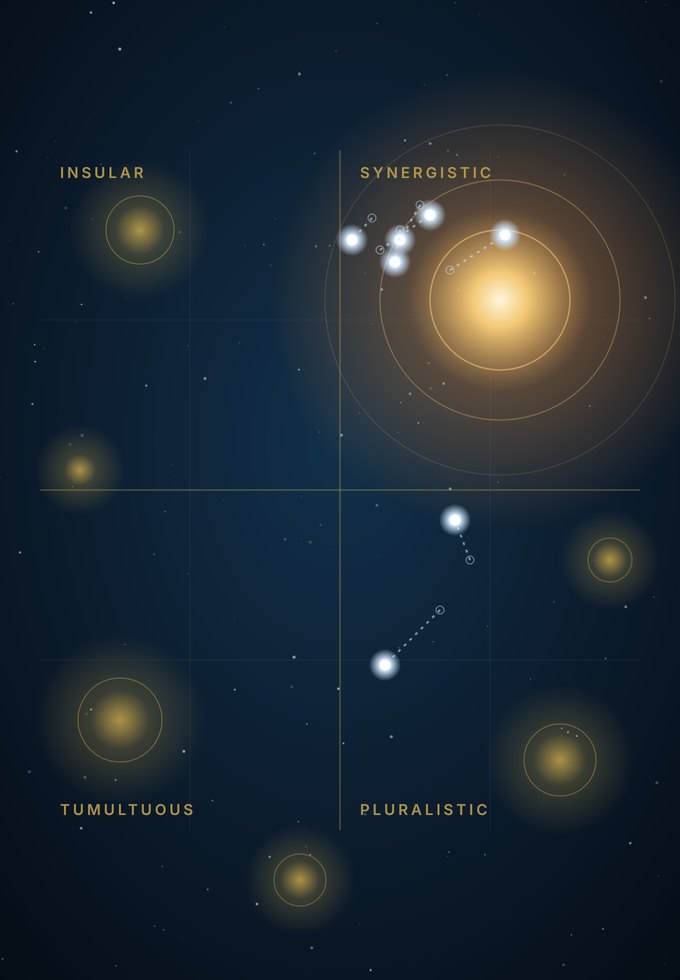
Natural Synergy describes an organization's operating state as the balance of two capabilities:
- Resilience: the ability to absorb shocks and execute reliably
- Ingenuity: the ability to keep creating new value
That balance places every organization in one of four states:
| State | Resilience | Ingenuity | What it looks like |
|---|---|---|---|
| Synergistic | High | High | Stable and innovative at the same time |
| Insular | High | Low | Reliable, but slow to change and easily blindsided |
| Pluralistic | Low | High | Full of ideas, but fragile and fragmented |
| Tumultuous | Low | Low | Reactive, unstable and often in crisis |
Operating states are not fixed. Organizations shift between them in response to hotspots: disruptions, inside or outside the organization, that force it to rebalance. Whether a hotspot pushes an organization toward synergy or away from it depends on how well its vision, strategy and culture hold together.
Approach
We used the same method behind Business Ingenuity's ExoScan assessment: a structured reading of an organization from public information alone, the way its customers, partners and competitors see it. Sources included earnings releases, regulatory filings, court rulings and reputable press coverage published through October 2026.
Starting from each company's 2025 placement in the book, we examined three kinds of force:
- AI: investment, product progress, partnerships and dependencies
- Non-AI external hotspots: trade policy, geopolitics, commodity and supply shocks, energy constraints, regulation and reputation
- Leadership change: new chief executives, restructured top teams and shifts in leadership style
We then judged the direction and strength of each company's movement. This is the view from outside, not a diagnosis. It cannot see a company's internal relationships, mood or culture, which only an internal survey can reveal.
Findings
Five of the seven held or strengthened their operating state, but only two did so without a visible new source of strain. AI appears among the main forces for most companies. It is never the only one.
| Company | Circa 2025 | Main forces since | Where it stands, October 2026 |
|---|---|---|---|
| Alphabet | Oscillating between Synergistic and Pluralistic | AI built on its own chips; antitrust appeals; EU fines | Firmly Synergistic |
| Nvidia | Synergistic | AI demand; loss of China; helium and rare-earth risk | Strongly Synergistic |
| Microsoft | Synergistic (at its peak) | AI spending; OpenAI exclusivity lost; memory costs; split leadership | Synergistic, weakening |
| Amazon | Synergistic | AI spending; tariffs absorbed by pre-buying; deep layoffs | Synergistic, hidden strain |
| Apple | Synergistic | Memory shock; tariffs; AI delays; CEO succession | Sliding toward Insular |
| Meta | Pluralistic | AI spending; 10% layoffs; first president appointed | Pluralistic, resilience improving |
| Tesla | Pluralistic | Political backlash; flat revenue; battery supply; leader's split attention | Pluralistic, at risk of Tumultuous |
Alphabet settled a question the book left open. Its Gemini models, trained on its own chips, drove Google Cloud revenue up 82% in the second quarter of 2026, and a federal judge declined to break up the company. Its vision of organizing the world's information turned out to be one AI fits naturally.
Nvidia grew stronger on both fronts. Quarterly revenue more than doubled to $96.2 billion, and its customer base broadened beyond a single dominant AI lab. It absorbed the near-total loss of China, which now contributes under 1% of data center revenue, without losing momentum.
Microsoft remains Synergistic, but its resilience is under strain. It lost exclusive access to OpenAI's models in April, while OpenAI still accounts for about 45% of the business Microsoft has under contract but not yet delivered. Planned 2026 capital spending of $190 billion and a shift to a more directive leadership style put pressure on the open, collaborative culture behind its transformation.
Amazon grew Amazon Web Services 28% and absorbed the 2026 tariff reversal because it had bought inventory in advance. But about 30,000 corporate job cuts since October 2025, and turnover on its senior leadership team, are thinning relationships that public financials cannot show.
Apple delivered record results while ceding ground on ingenuity. Its rebuilt Siri runs on Google's Gemini models. Its sharpest shock came through its supply chain: memory prices quadrupled as rivals built AI data centers, forcing price increases across its product lines. A hardware-focused CEO succession favors continuity over reinvention, the profile of a company sliding toward Insular: dependable, but slower to reinvent itself.
Meta is now behaving like two companies in one. AI made its advertising engine markedly more resilient, while its push to build "superintelligence," AI that outperforms people, shows classic Pluralistic signs: capital spending raised to $125–145 billion without what its chief executive called a "very precise plan" for every product. Appointing its first president, a finance and government veteran, adds the balancing skills the book recommends pairing with a visionary founder.
Tesla generated much of its own turbulence. Political backlash depressed sales, particularly in Europe. In its third quarter of 2026, revenue was flat, net income fell 43%, and the company named battery supply as the limit on vehicle volumes. Research spending on AI, robots and robotaxis rose 69%, while influence remains concentrated in a chief executive whose attention spans several companies and politics.
Patterns across the seven
- AI amplified; it didn't redirect. Companies whose vision, strategy and culture already fit together, such as Alphabet and Nvidia, compounded their advantage. Where they didn't fit, as in Meta's superintelligence push and Tesla's robotics bet, AI widened the gap and raised the stakes.
- Non-AI shocks tested resilience. A Supreme Court ruling struck down tariffs in February 2026, and a new 10% global tariff replaced them within days. The war with Iran pushed oil above $100 a barrel at times and cut off much of the world's helium, which chip fabs need. China banned exports of materials with military uses to 10 US companies. Companies with spare inventory, strong cash positions and varied suppliers absorbed these shocks; Tesla's biggest shock came from inside.
- The companies grew more dependent on one another. The AI buildout created other companies' shocks. Demand from the biggest cloud providers quadrupled memory prices for everyone, strained power grids and drew community opposition to new data centers. One company's growth bet became another company's supply problem.
- A new leadership pattern emerged: sharing the top job. Apple, Microsoft and Meta each paired a technical or visionary leader with a commercial or government-facing one. Done well, this brings in skills the chief executive lacks. Done poorly, it creates two centers of influence with no one bridging them.
- Job cuts carry a hidden cost. Most of the seven are cutting staff while spending heavily on AI computing power. Layoffs can remove the trusted relationships that keep work running smoothly, a cost no income statement records.
Implications for leaders
No one can predict the next hotspot. Leaders can build an organization that hears it early and responds coherently. Two capabilities matter most.
Loose ties sense hotspots. These are the less frequent connections across teams and outside the company: a supplier, a regulator, a local official, a customer in another market. They carry news that close-knit teams don't. When every outside conversation is about AI, loose ties narrow, and the organization stops hearing everything else.
Rituals turn signals into action. These are the regular forums where signals get a hearing and become decisions. Examples include:
- A quarterly brief comparing changes in your markets, supply chain and regulation against the assumptions behind your strategy
- Listening rounds in which the people who hold your loose ties report what they are hearing
- Scenario sessions that deliberately leave out AI
- A named owner for each category of hotspot
- A transition plan that protects key relationships whenever the top team changes
Three questions for your next leadership meeting:
- Apart from AI, which hotspot could most change our operating state in the next 18 months?
- Do our loose ties still reach suppliers, regulators and communities, or have they narrowed to one topic?
- When someone brings an unfamiliar signal, which ritual gives it a hearing?
How Business Ingenuity can help
The analysis in this case study is the kind of reading from public information that Edgy™, Business Ingenuity's AI agent educated by Natural Synergy, produces for any organization:
- ExoScan places an organization in its operating state from public information, shows which way it is heading, and flags where its public claims run ahead of the money and people behind them.
- OrgScan and OrgAnalysis add the inside view. These surveys reveal the relationships, mood and leadership patterns that determine whether an organization can respond to the hotspots it faces.
Request an ExoScan for your organization
About this analysis
This case study is an independent analysis based solely on publicly available information as of October 2026. Business Ingenuity has no relationship with the companies discussed, and none reviewed or endorsed this analysis. Operating state placements are interpretive judgments using the Natural Synergy framework, not statements of fact about any company's internal condition. This analysis is not investment advice.
Appendix: Natural Synergy terms
These terms come from Natural Synergy: From Mystery to Mastery by Charles Follett and Ray Scott (2026).
| Term | Meaning |
|---|---|
| Operating state | An organization's prevailing balance of resilience and ingenuity. Every organization is in one of four states at any time, and can move between them. |
| Resilience | The ability to absorb shocks and execute reliably. |
| Ingenuity | The ability to keep creating new value through innovation and adaptation. |
| Synergistic | High resilience and high ingenuity. Stable and innovative at the same time; the state that sustains the strongest performance. |
| Insular | High resilience, low ingenuity. Reliable and efficient, but inward-looking, slow to change and easily blindsided. |
| Pluralistic | High ingenuity, low resilience. Full of ideas, but fragmented, volatile and fragile under pressure. |
| Tumultuous | Low resilience and low ingenuity. Reactive and unstable, with shifting priorities and frequent crises. |
| Synergy | The condition of a Synergistic organization, where resilience and ingenuity reinforce each other. |
| Hotspot | A disruption, inside or outside an organization, that forces it to rebalance resilience and ingenuity. Examples include new technology, trade shocks, regulation and leadership change. |
| Vision, strategy and culture | The three essential components leaders use to shape an organization. Vision pulls people toward a shared future, strategy guides how to win, and culture defines shared identity and behavior. When they fit together, the organization holds steady through hotspots. |
| Loose ties | Less frequent connections across teams and outside the organization. They bring in new information and early signals. Sociologist Mark Granovetter called them "weak ties." |
| Rituals | The regular forums and practices through which an organization reinforces its values and turns what it hears into decisions. |
Sources
- Alphabet Q2 2026 results (Verdict)
- NVIDIA second quarter fiscal 2027 results (SEC filing)
- Nvidia Q2 FY2027: China below 1% of data center revenue (Rivkin)
- Microsoft Q2 2026 earnings summary (Fintool)
- Microsoft stock sinks as AI spending ramps to $190 billion (Yahoo Finance)
- Microsoft names CEO to run commercial business (Reuters)
- Amazon has cut 57,000 jobs while it pours $200 billion into AI (Startup Fortune)
- Amazon shares slide as huge AI spending plan rattles investors (ChannelNews)
- Amazon banks $600 million in tariff refunds (Karmactive)
- Apple reports third quarter results (Apple Newsroom)
- Apple raises Mac and iPad prices, citing memory cost surge (AI Weekly)
- Tim Cook's Apple legacy and the AI challenge his successor inherits (SoftwareSeni)
- Meta Q1 2026 results and capex guidance (Mobile World Live)
- Meta taps Dina Powell McCormick as president and vice chairman (Axios)
- Tesla Q3 2026 financial results (Electrek)
- Tesla bet big on Elon Musk. His politics continue to haunt it (Washington Post via ADN)
- Supreme Court strikes down IEEPA tariffs (Thommessen)
- Iran war disrupts helium supply, threatening chip supply chain (The Hill)
- China targets US rare earth firms with new export controls (Indonesia Business Post)
- Data centre moratoriums spread (Datacentres.com)