Why AI's most dangerous threat is the one already standing in your organization
Everyone is watching the wrong rhino
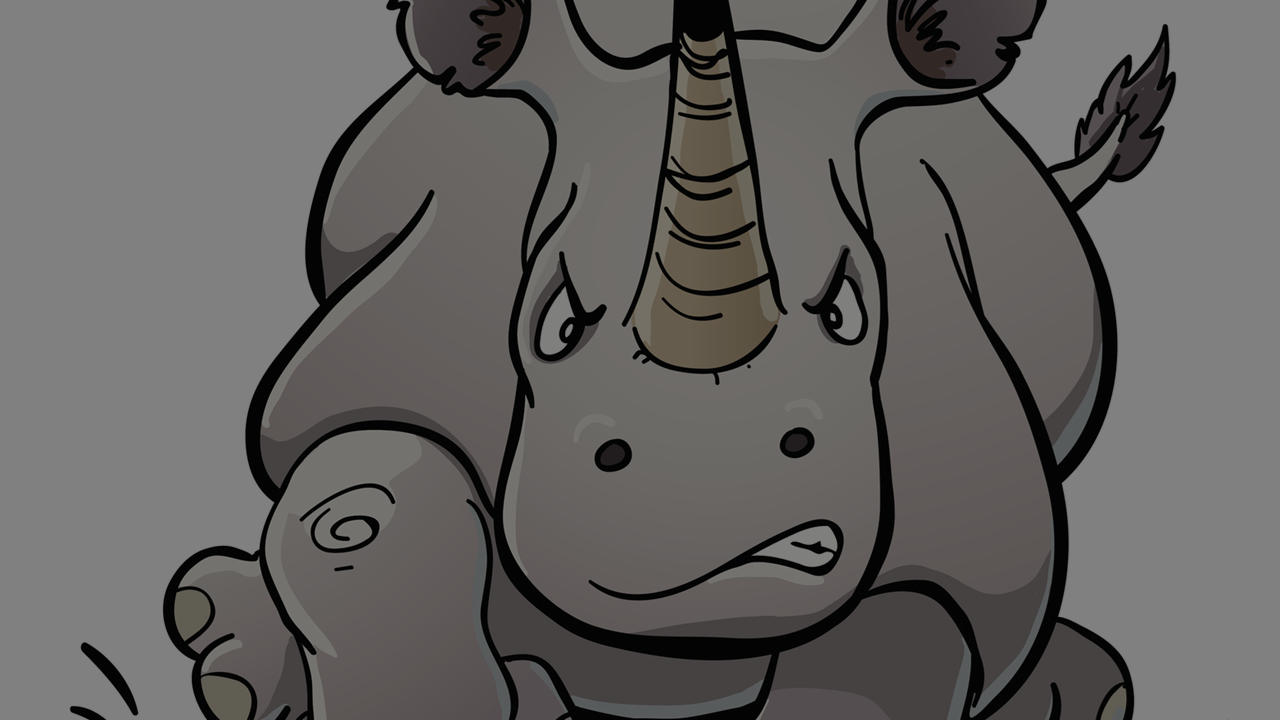
AI is not the gray rhino bearing down on your organization. Your organization is — and AI is what makes it charge faster.
Policy analyst and former think tank executive Michele Wucker introduced the term gray rhino at the World Economic Forum in Davos in 2013, then built a framework around it in her 2016 book, The Gray Rhino: How to Recognize and Act on the Obvious Dangers We Ignore. It was a deliberate counterweight to the black swan, which after the 2008–2009 financial crisis had become a convenient excuse for disasters that were, in fact, foreseeable. Her 2021 sequel, You Are What You Risk: The New Art and Science of Navigating an Uncertain World, goes a step further, examining how culture and organizations shape the risks people choose to take, or ignore.
A gray rhino is highly probable, high-impact, and plainly visible: a two-ton animal pawing the ground in front of you. Wucker's point was never that these threats are hidden. It was that most humans consistently fail to act on the obvious, but that this failure is not inevitable. Decision makers who recognize our vulnerability to neglecting obvious challenges are more likely to overcome it.
Most boardrooms today have a rhino everyone agrees they can see. It is labeled "AI risk": models that hallucinate, agents that act without authority, data that leaks, regulators that circle. Those risks are real. But the rhino that does the damage is standing closer. It is the same one that brought down Kodak, Eastern Airlines, and Blockbuster long before large language models: the organization's own culture, and the structural condition it has drifted into.
AI does not create organizational tumult on its own. It accelerates whichever drift an organization already has. That raises the stakes on culture, which is now the operating system every AI initiative runs on. An aligned organization will absorb AI's acceleration and compound it; a fractured one will simply fracture faster.
A new breed of rhino
Wucker's framework already anticipates complexity. One of her diagnostic questions is whether a particular gray rhino stands on its own or is part of a system of related threats. She calls the structural barriers that keep organizations from managing specific rhinos meta gray rhinos, and organizational dynamics fall squarely into that category.
AI makes that category more urgent. Organizations are complex adaptive systems — networks in which conversations, decisions, and commitments flow continuously. As network scientists such as Albert-László Barabási have shown, such networks form clusters, build self-reinforcing feedback loops, and at some threshold tip into a new state.
AI changes that network in three ways at once:
- Speed. Decisions, content, and code move faster than most governance cycles were designed to observe.
- New participants. Agentic AI doesn't just inform people; it acts, without waiting for the conversation to finish.
- Amplification. Whatever pattern already dominates — alignment or fracture, confidence or fear — spreads faster and farther.
The result is not one rhino but a crash of them: AI's own risks and the organization's dysfunctions, charging together. There is no single animal to point at. There is a trajectory.
The rhino you see, and the one you don't
Blockbuster saw its rhino: Netflix. What it missed was the network effect of the ecosystem around it, which tipped consumer behavior faster than Blockbuster could respond.
AI sets the same trap. The visible rhino is alpha risk: AI does something wrong. The less visible one is beta risk: the organization fails to adopt, or adopts in ways that never compound. Most boards watch the first and are blind to the second.
The deeper rhino, a meta gray rhino in Wucker's terms, is the structural pathway along which AI is quietly pushing the organization. In our work with the Natural Synergy framework, three pathways recur:
- Insular overreaction. Sign-offs multiply and pilots stall while leadership believes it is being prudent. The result is rigidity: strong execution, declining ingenuity.
- Pluralistic fragmentation. Some units race ahead while others stand still, and nothing integrates the gains. Bursts of brilliance never compound.
- Tumultuous agentic. Agents are deployed faster than governance can constrain them, and vision, strategy, and culture decouple. This is the most acute of the three.
None of these starts with AI; each is a pre-existing fault line that AI widens. A generic "AI risk score" tells you the rhino exists, not which direction it is charging.
Mood is still the canary
The earliest warning of a cultural rhino is the organization's mood. Moods are contagious, and negative ones spread fastest. Kodak had complacency, Eastern Airlines resentment, Blockbuster arrogance. AI gives each a new costume:
- Fear shows up as shadow AI: tools used quietly, failures hidden.
- Complacency sounds like "we'll wait until the technology matures."
- Arrogance sounds like "we're already an AI company," a claim the organization can't yet back up.
- Resentment grows where AI's gains and burdens are unevenly shared.
Each has a positive counterpart leaders can cultivate: confidence, ambition, humility, and respect. Moods are not soft data. They signal which way the network is about to tip.
The rhino outsiders see first
Your investors, customers, and competitors may see your rhino before you do. We call it the Credibility Gap: the distance between what an organization publicly claims and what it has actually resourced, governed, or deployed.
An "AI-first" story set against flat headcount or no visible investment is readable by anyone with public filings, hiring data, and product announcements. It is large, probable, and in plain view of everyone except the team telling the story. The most dangerous position is to be overclaimed and not know it.
Keeping the rhino at bay
A structural rhino is visible — and addressable — before an incident. Six moves make the difference:
- Ask both questions. For every AI initiative, ask what happens if it goes wrong and what it costs if you don't do it.
- Name the pathway, not just the risk. Overreaction, fragmentation, and agentic tumult need different, sometimes opposite, interventions.
- Treat latency as a leading indicator. Rising decision and pilot-to-production latency is the rhino lowering its head.
- Put an orchestrator at the gate. Before any agent reaches production, route it through a governance review led by someone focused on integration, not advocacy or control.
- Read yourself from the outside first. Run the public-evidence read a skeptical investor would, then fix the resourcing or fix the story.
- Start with the executive team. Aligned around a compelling AI vision, they form the cluster that attracts all others.
Sometimes the smartest move is not to fight the two-ton rhino but to ride it. The rhino is not hiding. It is standing in your hallways, your pilot backlog, and your investor deck. The only question is whether you act before it charges.
Business Ingenuity helps leadership teams see the structural rhinos AI is about to accelerate. The Edgy™ diagnostic suite, built on the Natural Synergy framework, reads an organization's Operating State and Credibility Gap from the outside in, then tests them from the inside out. Learn more at BusinessIngenuityInc.com.
Gray Rhino® is a registered trademark of Gray Rhino & Company, used with permission.