Competence, reliability and sincerity make an organization dependable. Only care makes it synergistic, and as AI agents take on more of an organization's work, care is becoming the scarcest form of trust.
Executive summary
Ask most leadership teams whether their organization is trusted and they will point to evidence of delivery: quality scores, on-time performance, customer satisfaction, a brand that keeps its promises. That evidence is real, but it measures the wrong thing. It shows that the organization is dependable. It does not show that the organization is synergistic.
Trust is not one thing. People judge an organization on four aspects: competence (can you do it?), reliability (will you do what you promised?), sincerity (do you mean what you say?), and care (do my concerns matter to you, and will you act on them when it costs you?). The first three are judgments about tasks and claims. Care is a judgment about the relationship itself, about whose future the organization is working for.
This paper argues that what sets synergistic organizations apart is not how much they are trusted but what they are trusted for. Organizations trusted on competence, reliability and sincerity can become very good reliable agents. Only organizations trusted on care become partners in what we call co-inventing the future.
Care-based trust is not something an organization announces. It is something people conclude. In a large organization, most people never meet the leaders whose decisions shape their future, so they judge care by the narrative, and not only the words. A narrative is credible when vision, strategy and culture align: the vision says whose future the organization is building, and the strategy and culture prove it through how resources are spent and how concerns are treated. When the three tell the same story, care shows up in every corner of the organization. When they diverge, people believe what the organization does over what it says, and they read the gap as indifference, or worse.
The question is now urgent. AI agents increasingly make decisions and conduct conversations on organizations' behalf. Those agents can be extraordinarily competent and reliable, but agents do not care, and they never will, because care requires someone who can be affected by the outcome. Agents are never affected, because there is no one there to affect; they are computational processes, optimizing toward goals someone else set. As competence and reliability become cheap and abundant, care becomes the scarcest and most decisive source of trust.
We illustrate the argument with five cases: Costco and Ford under Alan Mulally, where care-based trust is evident; Boeing and Wells Fargo, where it was absent or inverted; and Southwest Airlines, where it appears to be eroding. We close with practical tests for diagnosing care-based trust and seven practices for building it.
1. The problem: trust treated as dependability
When executives talk about trust, they usually mean delivery. Did the product work? Did the shipment arrive? Did the quarter land where we said it would? Organizations measure trust through quality metrics, service levels, on-time performance and net promoter scores, and invest accordingly in process discipline, quality systems and brand promises.
None of that is wrong. But in Building Trust, philosopher Robert Solomon and Fernando Flores warn that equating trust with predictable performance mistakes reliance for trust. They describe this as the "mechanization" of trust, and they argue that real trust has to go beyond competence. Reliance is what we place in a machine that has always worked. Trust is a relationship between parties who could let each other down and choose not to.
Solomon and Flores also identify two weak forms of trust that organizations often confuse with the real thing. Simple trust is the naive trust of someone who has never considered betrayal; it is pleasant but shatters at the first disappointment. Blind trust is willful: it refuses to look at the evidence. Neither survives contact with a hard quarter, a failed launch or a restructuring.
The organizational failure mode they name is cordial hypocrisy: the polite, smiling insistence that everything is fine when everyone knows it is not. Cordial hypocrisy looks like trust. Meetings are pleasant, dashboards are green, and the values statement is on the wall. Underneath, people have stopped telling each other the truth, because they no longer believe their concerns will be taken into account.
What Solomon and Flores call authentic trust is different. It is reflective and conditional, it acknowledges that betrayal is possible, and it can be rebuilt after a breach. It grows, they argue, when people become unafraid of honest negative assessments from those they respect. That last point is the bridge to our argument. People stop fearing honest criticism only when they believe the critic cares about them. Authentic trust, in practice, rests on care.
2. Four aspects of trust, and why care is different
The most practical way to separate these ideas comes from coaching practice. In the tradition that grew out of Fernando Flores's work on commitments and conversation, trust is treated as an assessment someone makes rather than a feeling they have. Coaches trained in that tradition learned three assessments: sincerity, reliability and competence. Charles Feltman, who trained in it, felt something was missing and added a fourth: care. His Thin Book of Trust made the four-part model widely used. When we decide whether to trust someone, we are making these four assessments, usually without noticing.
Exhibit 1. Four aspects of trust
| Aspect | The question the trusting party asks | What it earns | Where it tops out |
|---|---|---|---|
| Competence | Can you do it? | Credibility | A capable service provider |
| Reliability | Will you do what you promised, when you promised? | Dependability: "I can depend on you" | A reliable agent |
| Sincerity | Do you mean what you say? | Belief in your claims | Undone by any gap between claim and action |
| Care | Do my concerns matter to you, and will you act on them when it costs you? | Partnership: "We're co-inventing our futures" | No ceiling |
Source: adapted from Feltman (2021) and Business Ingenuity's Trust Matrix.
The first three aspects share something important. Each is an assessment of a task or a claim. Can you build this? Will you deliver it on time? Is your forecast honest? They can be checked against evidence, and organizations rightly invest in improving them.
Care is a different kind of assessment. It is a judgment about the relationship: whose future you are actually working for. Someone can be fully competent, reliable and sincere and still not care. A contractor can deliver a flawless project on schedule and mean every word of its proposal while being entirely indifferent to what happens to the client afterward. That contractor is trusted, but only as a reliable agent, much as we trust a well-designed AI system: to perform, not to care.
Care also changes how the other three are judged. Every organization eventually fails on competence or reliability: a product launch slips, a system goes down, a forecast misses. Solomon and Flores note that breaches of trust can be repaired through acknowledgment, apology and forgiveness, and that authentic trust survives them. But that repair depends on what the trusting party believes about care. When people believe an organization cares about them, a failure is read as a mistake to be fixed together. When they doubt it, the same failure is read as betrayal, evidence of what the organization really values.
This is why care sits underneath the other three rather than beside them. Competence, reliability and sincerity determine whether an organization is useful. Care determines whether its failures will be forgiven, whether people will tell it the truth, and whether they will invest their own ingenuity in its future.
Feltman reaches a similar conclusion. People who doubt that you care about their interests may still rely on your sincerity, reliability and competence, but only within narrow, specific situations. Care is what allows trust to extend beyond the transaction.
3. Reading care in the Trust Matrix
Business Ingenuity's Trust Matrix maps relationships on two dimensions. The vertical axis is the degree of trust, from betrayal and distrust at the bottom to mutual alignment at the top. The horizontal axis is strategic importance, from cost center and support function on the left to strategic business partner on the right. The four quadrants correspond to the four operating states of the Natural Synergy™ framework. The matrix is adapted from Trust in Customer Relationships (1991), developed by Business Design Associates, the consulting firm Fernando Flores led, so it shares its roots with the trust tradition described above.
Exhibit 2. Trust in Team and Client Relationships
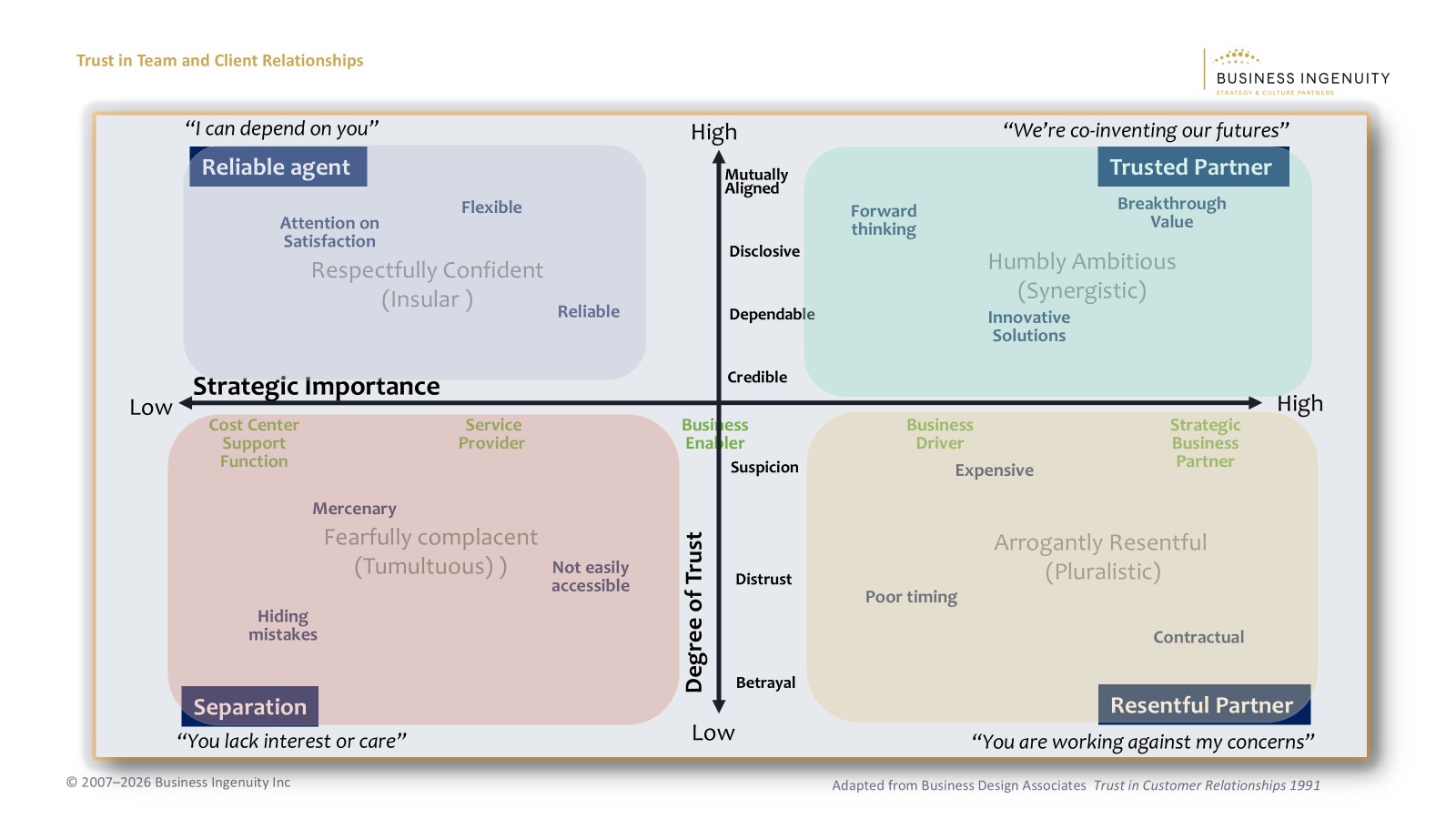
Source: Business Ingenuity, Inc., Trust in Team and Client Relationships (2007–2026), adapted from Business Design Associates, Trust in Customer Relationships (1991).
The matrix is worth reading closely, because the language of its corners already points to care.
The two low-trust quadrants are both described as failures of care. In the lower left, the Tumultuous state, the relationship has decayed into separation, and the voice of the other party says: "You lack interest or care." Care is absent. People keep their distance, mistakes are hidden, and nobody is easy to reach. In the lower right, the Pluralistic state, the relationship has become adversarial: "You are working against my concerns." Here care is inverted. The parties still matter to each other strategically, which is exactly why the betrayal stings. Suspicion, contractual hedging and mercenary behavior follow.
Neither low-trust quadrant is defined by incompetence or unreliability. Both are defined by what the other party believes about care.
The two high-trust quadrants differ in the kind of trust, not its amount. The upper left, the Insular state, is the reliable agent: "I can depend on you." Trust here rests on competence and reliability. The relationship is flexible and credible, and attention stays on satisfaction. It is respectfully confident, and it can be highly profitable. But it is closed. The parties deliver for each other without inventing anything together.
The upper right, the Synergistic state, is the partnership: "We're co-inventing our futures." The relationship is disclosive, mutually aligned and forward-thinking, and it produces breakthrough value and innovative solutions. Those qualities are not simply more reliability. They are what reliability becomes when people believe the other party is working for their future.
Business Ingenuity's version of the matrix for client relationships makes the step explicit. The reliable agent "listens, clarifies conditions of satisfaction, and reliably delivers." The trusted partner "listens for what is unspoken and wanted, and makes offers." Attending to concerns that have not been voiced, and offering something before being asked, is what care looks like in practice.
The implication for leaders is direct. An Insular organization will not become Synergistic by becoming more reliable. It is already reliable. The move from left to right on the matrix runs through care.
4. Care at scale is a property of the narrative
Between two people, care is judged face to face. We watch how someone listens, whether they remember what matters to us, and what they do when helping us costs them something. An organization of thirty thousand people cannot be judged that way. Most employees will never meet the CEO, and most customers will never meet anyone with authority over the decisions that affect them. So how does anyone judge whether an organization cares?
The answer is that people gauge care by comparing what leaders say with what they experience every day.
Historian Yuval Noah Harari offers a useful lens. In Sapiens, he argues that what lets humans cooperate flexibly in very large numbers, with strangers they will never meet, is shared stories. Money, nations, laws and corporations are what he calls imagined orders: they exist because enough people believe in them and act accordingly. A corporation is itself one of these stories. It has no physical existence apart from the shared belief of employees, customers, investors and regulators that it exists and means something.
If that is true, then the narrative is not a communications asset. It is the mechanism by which thousands of strangers coordinate. It tells them whose future they are building and how to act when no one is directing them.
Natural Synergy™ describes that narrative as the alignment of three elements:
- Vision says whose future the organization exists to serve.
- Strategy shows where resources actually go. Care is proved by what an organization is willing to spend, or give up, on someone's behalf.
- Culture shows how concerns are treated when no one important is watching.
When the three tell the same story, care becomes legible in every corner of the organization. A frontline employee, a supplier or a customer can see it without meeting a single executive, because the resource decisions and the daily behavior they encounter match what the organization says it stands for.
When the three diverge, people believe the strategy and the culture, not the vision. A company that announces "customers first" while rewarding staff for extracting fees has told its customers the truth about care, just not in the words of its mission statement. Natural Synergy™ calls this mismatch between public claims and public resourcing a Credibility Gap. It is usually discussed as a failure of sincerity, but it is experienced as a failure of care.
Harari's later book, Nexus, adds a second point. He argues that every information network must balance two needs: truth and order. Networks that survive and adapt build strong self-correcting mechanisms, ways for errors to be surfaced and fixed. Networks that put order ahead of truth suppress the bad news that would let them course correct.
Inside an organization, care-based trust is what makes self-correction work. People raise problems when they believe the organization cares what happens to them for doing so. A narrative that rewards order over truth produces exactly the cordial hypocrisy Solomon and Flores warn about: green dashboards, polite meetings and unspoken risk.
Solomon and Flores close their discussion of authentic trust with leadership as "disclosing new worlds": the leader's role is to open up a future that people can commit to. That is the narrative function described in the language of trust. A leader discloses a world in which people's concerns are held, and then has to make the strategy and culture prove it.
5. AI doesn't care: why care becomes the deciding test
The argument so far would have held at any point in the last fifty years. What makes it urgent now is artificial intelligence.
Harari's central warning about AI is that it is different in kind from every earlier technology. A printing press could copy a book but could not write one. AI can write, decide and generate new ideas on its own. In his words, "AI isn't a tool—it is an agent." Organizations are already deploying it that way: AI agents now draft customer correspondence, screen job applicants, set prices, approve or deny claims, schedule crews and recommend which roles to cut.
Harari also draws a distinction that matters directly for trust. He separates intelligence, the ability to pursue and attain goals, from consciousness, the ability to feel things such as pain, pleasure or love. In humans the two have always come together. In AI they come apart. An AI system can be highly intelligent in pursuing the goal it was given while experiencing nothing at all.
That is the heart of the problem for care-based trust. An AI agent can be extraordinarily competent. It can be more reliable than any human team. It can even be made to sound sincere. But it does not care, because there is no one there to care. It has no stake in your future and nothing to lose by failing you.
Exhibit 3. What an AI agent can and cannot carry
| Aspect of trust | Can an AI agent deliver it? | The main risk |
|---|---|---|
| Competence | Yes, often better than people | Over-reliance, and errors nobody owns |
| Reliability | Yes, within the conditions it was built for | Brittle when the context shifts |
| Sincerity | It can imitate sincerity | Discovery reads as hypocrisy |
| Care | No: it has no stake and feels nothing | Simulated care in place of real care |
Source: author's analysis, drawing on Harari (2024).
Three risks follow for organizations that want care-based trust.
Simulated care. AI makes it cheap to produce the language of care at scale: empathetic emails, personalized check-ins, apologies that sound heartfelt. When people discover that the warmth was generated rather than felt, they experience it as cordial hypocrisy on an industrial scale. Trust in the organization's sincerity collapses, and trust in its care goes with it.
Delegated decisions. When an AI agent decides on a loan, a schedule, a claim or a layoff, the person affected asks the oldest question in trust: does anyone here care about my concerns? An agent pursues the metric it was given, not the person in front of it. Unless a human remains visibly accountable for the outcome, the honest answer is no. An early, pre-AI warning came from Boeing's MCAS, an automated flight-control system that acted on the aircraft without pilots having been told about it. Automation that acts on people without anyone owning their concerns is how care disappears from a system without anyone deciding to remove it.
Narrative drift. AI is often deployed one use case at a time, for efficiency, without asking whether each deployment fits the organization's vision and culture. Each decision looks reasonable alone. Together, they can quietly rewrite what the organization values in practice. Harari points out that AI can now generate the stories societies run on. Inside a company, an organization that lets automated systems write its customer and employee interactions has handed part of its narrative to an author that cannot care. The drift runs toward Tumultuous ("you lack interest or care") or Pluralistic ("you are working against my concerns").
There is also an opening here. As AI makes competence and reliability abundant and cheap, they stop distinguishing one organization from another. Every competitor will have access to capable, dependable agents. What they will not all have is care. The scarcer it becomes, the more it decides who is trusted as a partner.
The design principle that follows is simple to state: let AI carry competence and reliability, and keep a human accountable for care. Solomon and Flores locate trust in the making and keeping of commitments. An agent with nothing at stake cannot make a commitment in that sense. A person can, and the people affected need to know who that person is. In Natural Synergy™ terms, AI deployed faster than the accountability around it is a governance Credibility Gap, and it is one of the fastest ways to lose care-based trust.
6. Why care-based trust produces synergy
It would be easy to read the argument so far as a moral one: caring organizations are better organizations. That may be true, but the case here is practical. Care-based trust is the mechanism that makes an organization both resilient and inventive at the same time, which is what Natural Synergy™ means by the Synergistic state.
Care produces resilience through disclosure. Organizations do not fail because problems arise. They fail because problems are hidden until they are too large to fix. People surface bad news, early warnings and emerging risks only when they expect that doing so will be met with help rather than blame. In the Trust Matrix, this is the shift from "hiding mistakes" in the lower half to "disclosive" in the upper right. Care is what makes disclosure safe, and disclosure is what lets an organization correct itself before small hotspots become crises.
Care produces ingenuity through offers. Reliable agents deliver what was asked for. Partners offer what was not. Offering an idea, challenging an assumption or volunteering effort beyond the job description is a risk, and people take that risk only for an organization they believe is looking after their future. Ingenuity is a discretionary contribution, and care is what earns it.
Care makes the system self-correcting. Solomon and Flores observe that authentic trust grows when people are no longer afraid of honest negative assessments from those they respect. That is a description of a feedback loop. An organization with care-based trust can absorb criticism, hear dissent and change course without fracturing. An organization without it either suppresses criticism (and drifts toward Insular complacency) or experiences criticism as attack (and drifts toward Pluralistic conflict).
In Natural Synergy™ terms, care-based trust is one of the most powerful accelerators an organization can have, and its absence is one of the most common arrestors. It does not replace strategy, capital or talent. It determines whether those assets compound or cancel each other out.
7. Five cases
The following cases are drawn from public reporting. They are not offered as complete histories of these companies, but as clear illustrations of how care-based trust shows up, or fails to, when vision, strategy and culture align or diverge.
Where care-based trust is evident
Costco: care proved by what it gives up
Costco's founding narrative ranks its obligations in an unusual order: members first, employees second, suppliers third, and shareholders last. Co-founder Jim Sinegal argued that if the company took care of the first three, the shareholders would be rewarded. What makes the narrative credible is that the strategy pays for it.
Costco caps its markups at 14% on branded goods and 15% on its own Kirkland Signature products, well below what most retailers take. Its $1.50 hot dog and soda combo has not changed price since 1985; rather than raise it, the company built its own hot dog plants to keep costs down. On the employee side, Costco has long paid well above the retail average, with benefits that analysts once criticized as too generous. In early 2025 it raised pay so that most U.S. store workers earn more than $30 an hour, and CEO Ron Vachris told employees he expected Costco's wages and benefits to keep far outpacing the rest of retail. Its employee turnover is low for the sector.
The important point is that Costco gives up margin it could easily take. Care is proved by sacrifice, and members read the markup cap and the hot dog not as good service but as evidence that the company is on their side. The result shows up in membership renewal rates of around 90%. On the Trust Matrix, Costco sits firmly in the Synergistic quadrant: its relationship with members is a partnership, not a transaction.
Ford under Alan Mulally: care rebuilt through narrative
When Alan Mulally arrived as CEO in 2006, Ford was losing billions and run as a collection of competing regional fiefdoms. He replaced that with a single narrative, "One Ford": one team, one plan, one goal. The strategy funded the story. Late in 2006 Ford mortgaged nearly all of its assets, including the Blue Oval logo itself, to secure about $23.5 billion in financing for the turnaround. That decision later allowed it to be the only Detroit automaker to avoid a government bailout in 2009.
The culture shift came through a weekly meeting. In Mulally's Thursday Business Plan Review, every senior executive reported status using green, yellow or red. At first the charts were a sea of green, even though the automotive business was on its way to losing $17 billion that year. Then Mark Fields, head of the Americas, reported red: a tailgate latch problem had halted production of the new Ford Edge. Fields later recalled the tension in the room. Mulally clapped, praised the visibility, and asked what the team could do to help.
That moment is a precise illustration of care-based trust. Nothing about competence or reliability changed in that room. What changed was what executives believed about the consequences of telling the truth. Disclosure became safe, red slides began appearing across the company, and Ford could finally correct its problems. On the Trust Matrix, Ford moved from Pluralistic infighting toward partnership. The case shows that care-based trust can be rebuilt, and that a narrative made real through strategy and culture is how it happens.
Where care-based trust is not evident
Boeing: care absent
For decades, Boeing's reputation rested on engineering excellence. Its trust was trust in competence and reliability, and it was enormous.
Many observers, including airline CEOs and former employees, trace a shift in Boeing's culture to its 1997 merger with McDonnell Douglas, after which cost discipline and shareholder returns increasingly took precedence over engineering judgment. In 2001 the company moved its headquarters from Seattle to Chicago, physically separating leadership from the people who designed and built the aircraft. Two 737 MAX crashes in 2018 and 2019 killed 346 people, and investigations found that Boeing had not been transparent about the automated MCAS system. In January 2024, a door plug blew out of a new 737 MAX 9 on Alaska Airlines Flight 1282, and reports indicated that bolts meant to secure it appear to have been missing when the plane left the factory.
The instructive point is the order of events. Competence did not disappear first. Care did: concern for the people flying the aircraft, and attention to the engineers raising problems, were subordinated to cost and schedule. Once the public doubted that Boeing cared, every subsequent quality lapse was read as confirmation. On the Trust Matrix, this is drift toward Tumultuous: "You lack interest or care." Trust built on competence alone proved brittle.
Wells Fargo: care inverted
Before 2016, Wells Fargo had one of the strongest reputations in American banking. Its public narrative said that its selling model was grounded in customers' needs. Its strategy and culture said something different. The bank pursued an aggressive cross-selling goal of eight products per customer, and employees who missed sales quotas were berated. To meet them, employees opened an estimated 3.5 million deposit and credit accounts without customers' authorization. In 2020 the bank agreed to pay $3 billion to settle federal criminal and civil investigations, and regulators found its public disclosures about customer-centered selling inconsistent with what was happening inside.
Wells Fargo was reliable at hitting its targets, and its public language was polished. What failed was care, and in the most damaging way: the organization was actively working against its customers' concerns, and it set employees against the customers they were supposed to serve. On the Trust Matrix this is the Pluralistic state, "You are working against my concerns", the zone of betrayal. It is the most expensive kind of breach to repair, and the bank spent years under regulatory restriction as a result.
Drift: when care-based trust erodes
Southwest Airlines: from family to cost focus
For five decades Southwest was the standard business-school example of an employees-first narrative. Its employees called themselves "Cohearts", and the company told new hires that it had never had mass layoffs, a record it kept through recessions, the September 11 attacks and the pandemic. Customers saw the same narrative in policies such as "bags fly free" and open seating.
Signs of erosion have accumulated. In December 2022 an operational meltdown cancelled about 16,700 flights during the holiday season; employees blamed outdated crew-scheduling software that the company had not modernized, an example of strategy failing to resource the narrative. Under pressure from activist investor Elliott Management, Southwest then announced the end of open seating and, from May 2025, began charging for checked bags. In February 2025 it announced its first mass layoffs, cutting 1,750 corporate jobs, about 15% of its corporate workforce.
Each decision has a business rationale, and none of them alone ends care-based trust. Together, they illustrate how a Synergistic organization can drift toward Insular: still competent and reliable, but no longer clearly working for the futures of its people and customers. The case matters because it shows that care-based trust is a state, not a permanent trait. It has to be renewed through the narrative or it erodes.
Exhibit 4. The five cases on the Trust Matrix
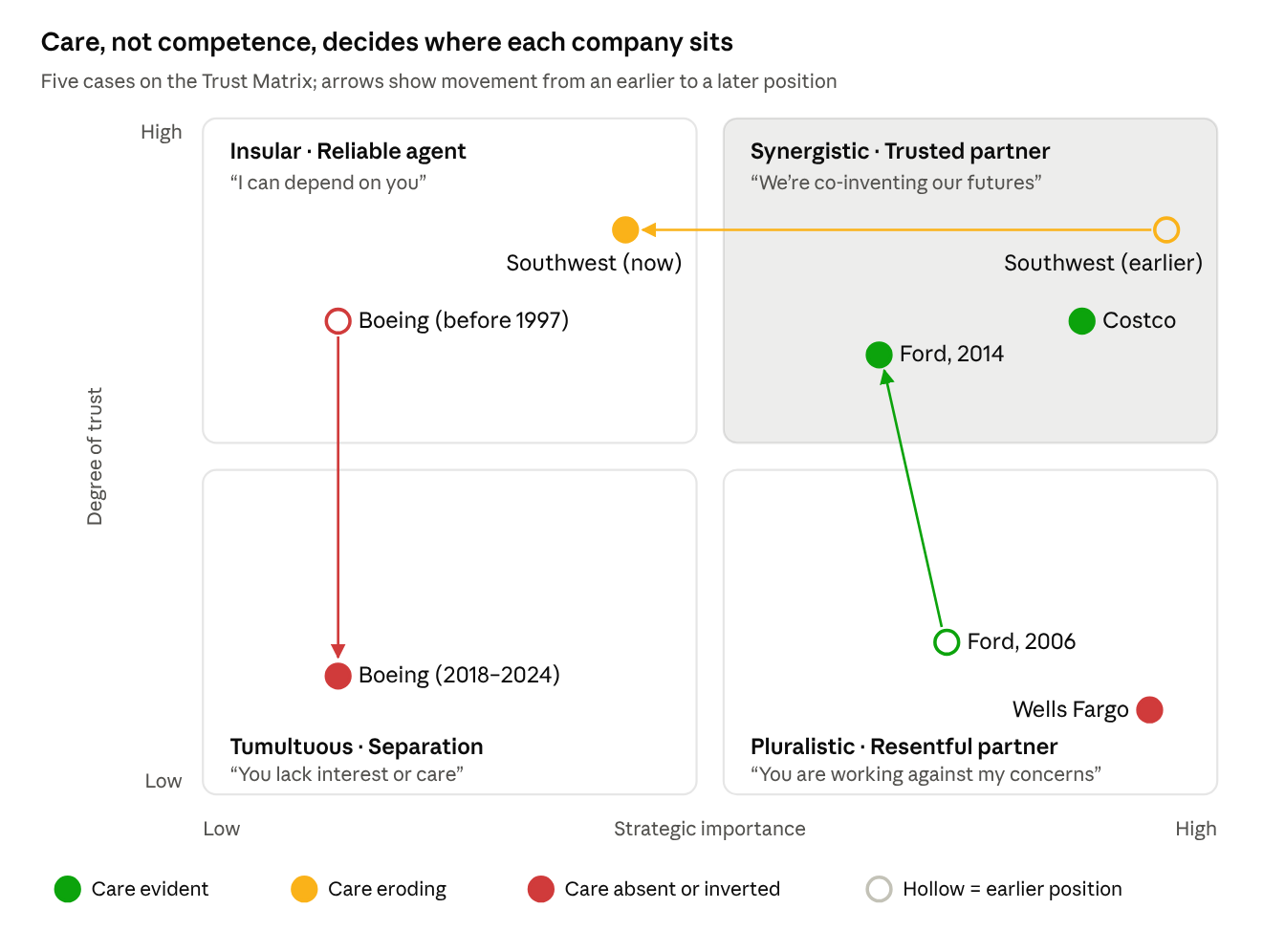
Source: author's interpretation of public reporting (see References). Placement is by quadrant only and is not a measurement. Two organizations moved into or held the Synergistic quadrant through care; two fell out of it through the absence or inversion of care; one is drifting.
8. Diagnosing care-based trust
Most trust measurement, such as engagement surveys, customer satisfaction scores and reputation indices, blends the four aspects of trust into one number. That number can look healthy in an Insular organization that is reliable but not caring, and it often moves only after care has already eroded. Leaders need tests that isolate care.
Five observable signals are a useful start:
- What happens to the messenger. Track what happens to people who bring bad news. If the honest answer is "nothing good", care-based trust is low, whatever the engagement scores say.
- Where the money goes. Compare the organization's three stated priorities with its last three resource-allocation decisions. Gaps between the two are read as statements about care.
- Commitments across levels. Check whether promises made to frontline staff, suppliers and customers are kept as reliably as promises made to the board and investors.
- How failure is interpreted. When something goes wrong, do people describe it as a mistake to fix together or as proof of what leadership really values?
- Who owns the outcome when a machine decides. Wherever AI agents act on employees, customers or partners, is a named person accountable for the result, and do the people affected know who it is?
These signals can be read from two directions. From the outside, public information already reveals a great deal: the gap between what an organization claims and how it allocates resources is visible in filings, hiring patterns, product decisions and press coverage. From the inside, carefully designed survey questions can separate trust in care from trust in competence, reliability and sincerity, and show where in the organization each is strong or weak.
Business Ingenuity's Edgy diagnostics were built to do both: to read an organization's narrative alignment and Credibility Gap from public data, and to measure the internal trust and operating-state dynamics behind it, including where AI deployment is outrunning the accountability around it.
9. Building care-based trust: seven practices for leaders
Care-based trust cannot be announced. It is built by making the narrative true, one decision at a time. Seven practices make the difference.
- Make commitments explicit, and keep them. Solomon and Flores describe trust as an emotional skill built through promises and commitments. Treat commitments to employees, customers and partners with the same rigor as commitments to investors, and make it visible when they are kept.
- Listen for what is not being said. The trusted partner listens for concerns that have not been voiced and makes offers before being asked. Build that habit into account management, leadership routines and product design.
- Resource the narrative. Put money and people behind the care you claim or stop claiming it. Every gap between stated priorities and actual spending is read as a statement about care.
- Build rituals that surface hotspots early. Mulally's Business Plan Review worked because it was weekly, mandatory and safe. Create regular forums, and the loose informal ties across the organization, where emerging problems can be raised before they become breaches.
- Treat breaches as relationship events. When trust is broken, fix the process and repair the relationship: acknowledge it, apologize, and show what will change. Authentic trust can be renewed; neglected breaches harden into distrust.
- End cordial hypocrisy. Reward people who deliver honest negative assessments, starting with those who deliver them to you. Green dashboards that everyone knows are wrong are more damaging than red ones.
- Keep a human accountable for care wherever AI acts. Let AI agents carry competence and reliability. Never let an agent be the only party standing behind a promise to an employee, customer or partner. Name the person who owns the outcome, and make sure the people affected know who it is.
10. Conclusion
Competence earns an organization a seat at the table. Reliability keeps it there. Sincerity makes its words worth listening to. Only care gets it invited to shape the future.
The distinction matters more now than at any time in the history of modern management. AI is making competence and reliability abundant, and capable agents will soon be available to every competitor. Those agents will not care, and the people they serve will be able to tell. As the other aspects of trust become commodities, care becomes the scarce one.
Synergy is not a culture program, and care-based trust cannot be installed. It is what people experience when an organization's story about whose future it serves turns out to be true in every corner: in the vision leaders articulate, in the resources the strategy commits, and in how the culture treats someone who brings bad news. Organizations that make that story true will be trusted as partners. The rest will be trusted, at best, as reliable agents.
About the author
Charles Follett is co-founder of Business Ingenuity, Inc. and co-author, with Ray Scott, of Natural Synergy™: From Mystery to Mastery. His work helps organizations unlock the performance that culture has been capping, by closing the gap between what leadership intends and how the organization actually behaves.
Business Ingenuity's Natural Synergy™ framework treats organizations as complex adaptive systems. It was field-tested with Fortune 1000 clients, and it underpins Edgy, an AI agent educated by Natural Synergy™ that reads an organization's operating state, the alignment of its vision, strategy and culture, and its Credibility Gap.
To see where your organization sits on the Trust Matrix, visit Business Ingenuity.
References
Books and frameworks
- Business Ingenuity, Inc. Trust in Team and Client Relationships matrix. 2007–2026. Adapted from Business Design Associates, Trust in Customer Relationships, 1991.
- Feltman, Charles. The Thin Book of Trust: An Essential Primer for Building Trust at Work. 2nd ed. Bend, OR: Thin Book Publishing, 2021. First published 2008.
- Feltman, Charles. Interview on the four distinctions of trust. The Game of Teams podcast.
- Follett, Charles, and Ray Scott. Natural Synergy™: From Mystery to Mastery. 2026.
- Harari, Yuval Noah. Sapiens: A Brief History of Humankind. London: Harvill Secker, 2014.
- Harari, Yuval Noah. Nexus: A Brief History of Information Networks from the Stone Age to AI. New York: Random House, 2024.
- Harari, Yuval Noah. "Artificial Intelligence: A Guest Post by Yuval Noah Harari." Barnes & Noble Reads, 2024.
- Solomon, Robert C., and Fernando Flores. Building Trust: In Business, Politics, Relationships, and Life. New York: Oxford University Press, 2001.
Case sources
- Costco: Cole Tretheway, "How Costco Makes Money Despite $1.50 Hot Dog Combos," The Motley Fool, December 5, 2025. "Costco Raises Hourly Pay," CBS News, January 2025. "Costco's founder once told the company's current CEO…," Business Insider.
- Ford: "Ford's Slow-Motion CEO Succession Plan," Bloomberg Businessweek, November 15, 2012. "How Ford Earned Its Blue Oval Back," Time, 2012.
- Boeing: Brooke Sutherland, "Boeing's Culture Needs an Overhaul," Bloomberg Opinion, January 23, 2024. "Analysis: Boeing Debacle Unmasks Tension Between Safety and Profits," Twin Cities Business, 2024.
- Wells Fargo: Associated Press, "Wells Fargo to Pay $3B to Resolve Probes into Fake Accounts," February 21, 2020. Anne Sherry, "Wells Fargo to Pay $3B to Settle Charges over Fake Accounts," February 24, 2020.
- Southwest: Ramishah Maruf, "Southwest to Lay Off 15% of Its Corporate Staff," CNN, February 17, 2025. Alison Sider and Chip Cutter, "Southwest Airlines Promised to Take Care of Employees—Until It Couldn't," The Wall Street Journal, March 3, 2025. "Southwest Airlines: All the Changes Coming," FOX 11 Los Angeles, 2025.