ABSTRACT
This case study examines how a €2B hydro-electric manufacturer reversed margin stagnation by treating culture—not cost cutting or pricing—as the primary strategic lever. By introducing a shared language for accountability and coordination, leadership shifted the organization from an Insular operating state toward a Synergistic-leaning state, restoring resilience, collapsing hidden coordination costs, and improving profitability without resorting to adversarial claiming. The case illustrates how executives can intentionally redesign control and authority in a complex adaptive system to achieve durable performance gains.
CASE STUDY
Massive Hydro-Electric Plant Construction
Shifting an Insular System Toward a Synergistic Operating State
Executive Context
Delivering a turnkey hydro-electric power plant is among the most complex industrial undertakings in the world. Engineering spans years, components are sourced globally, assembly occurs in remote locations, and contractual performance guarantees are not fully validated until the very end of the project—when non-conformance can cost more than €100,000 per day. In this environment, execution risk compounds quickly, and small coordination failures cascade into large financial consequences.
This case examines how the CEO of a €2B European hydro-electric manufacturer increased margins—without reducing headcount, raising prices, or resorting to adversarial contract “claiming”—by deliberately reshaping how accountability, coordination, and authority interacted inside the organization. The result was a shift from an Insular operating state toward a Synergistic-leaning state, marked first by resilience, and later by the emergence of adaptability.
Situation: A High-Stakes System Under Constraint
Over a three-year period, Large Hydro’s margins had flattened despite strong demand and world-class engineering capability. Competitive dynamics ruled out pricing moves, and cost reductions through layoffs
would have undermined execution capability. The only historically reliable lever for recovering margin was aggressive end-of-project claiming—an approach that damaged trust with customers and eroded future deal flow.
The system was operating close to its tolerance limits. Warranty obligations consumed scarce margin, late-stage surprises were common, and execution teams relied on heroic intervention during commissioning to avoid catastrophic penalties.
Diagnosis: An Insular Operating State Disguised as Operational Excellence
From a Natural Synergy perspective, Large Hydro was not failing due to a lack of competence. It was failing due to how competence was coordinated.
The organization exhibited the hallmarks of an Insular operating state:
- Strong local optimization within functions (sales, engineering, sourcing, manufacturing)
- Fragmented “local languages” for commitments, decisions, and handoffs
- High dependence on positional authority late in the project lifecycle
- Recurrent heroics during commissioning as the primary risk-mitigation mechanism
Analysis of recent projects revealed two recurring stress points with outsized financial impact:
- Sales-to-Execution Handover
Execution teams routinely discovered late that contracts, as written, required near-impossible margin recovery through redesign and sourcing gymnastics. What followed were protracted fights over feasibility, authority, and accountability—setting a tone of distrust early in the project. - Commissioning and Plant Turnover
As contractual performance deadlines approached, authority collapsed onto a small group of commissioning leaders. Emergency engineering deployments, expedited parts, and unplanned logistics became the norm. Success depended less on system reliability than on exhaustion-driven heroism.
The result was a steadily rising Cost of Poor Coordination, visible as increasing Cost of Poor Quality (COPC), volatility in margins, and late-stage fire-fighting.
Leadership Insight: Culture as the Primary Control Surface
The CEO recognized that traditional levers—process tightening, additional oversight, or structural reorganization—would not address the underlying failure mode. The problem was not insufficient control, but misaligned control in a complex adaptive system.
Drawing on prior experience, the CEO identified a missing system property: a shared language for accountability and coordination that could operate across functions, geographies, and disciplines without central micromanagement.
This was a deliberate leadership move:
- Authority was used to stabilize the system
- Not by imposing more rules, but by enabling coherence
- Long enough for new coordination norms to emerge
Culture was not treated as an enabler of strategy—it became the principal strategy.
Intervention: Introducing a Universal Language for Action
A cross-functional core team, reporting directly to the CEO, was tasked with redesigning Large Hydro’s end-to-end execution model around a common language derived from the Flores-Winograd action cycle (often referred to as the accountability loop).
Key design principles guided the intervention:
- Make expectations explicit without over-specifying behavior
- Reduce interpretive ambiguity at decision boundaries
- Preserve local adaptability while improving global coherence
Through extensive interviews, the team confirmed a shared diagnosis:
World-class engineering was not the issue; world-class coordination was.
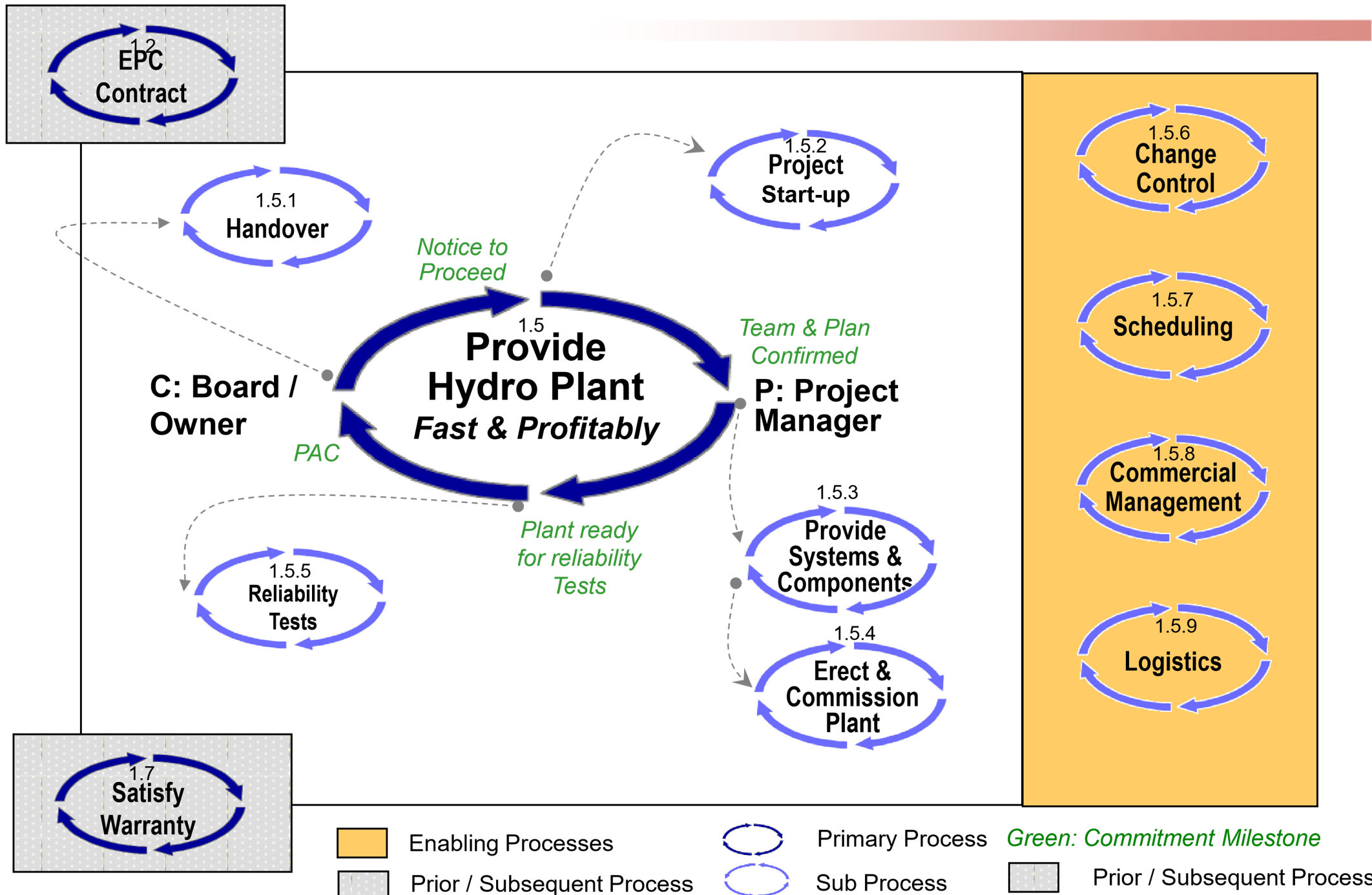
The resulting “playbook” logic illustrated below translated the language-action distinctions into:
- Clear accountability definitions at every project phase
- Explicit commitments between internal customers and performers
- Standardized decision outcomes for key meetings
- Multi-level process maps linking strategic intent to daily execution
Crucially, this was not positioned as a process compliance initiative. It was framed as a coordination infrastructure for a highly complex system.
Deployment: Authority in Service of Emergence
Once approved by the CEO and senior leadership team, the core team was mandated to deploy the playbook globally. Leadership did not delegate this as a training exercise; it was treated as a strategic system upgrade.
Executives reinforced three non-negotiables:
- The common language applied across power boundaries
- Execution teams were included early in defining commitments
- Accountability was shared, not deferred to late-stage authority
This recalibrated how authority functioned inside the system—from positional arbitration to relational orchestration.
Results: Resilience Before Profitability
Operational effects appeared well before financial outcomes:
- Sales-to-execution handovers shifted from adversarial to collaborative
- Early design decisions stabilized downstream execution
- Components arrived on site synchronized and interoperable
- Commissioning evolved from crisis management to validation
From a Natural Synergy lens, the organization first achieved resilience: the ability to deliver reliably under stress without extraordinary intervention.
Only then did financial performance follow. Net margins improved dramatically—not through price increases or headcount reductions, but through the collapse of coordination costs previously hidden inside COPC.
Leading Indicators of System Health
Beyond lagging financial results, leadership tracked early signals that the operating state had shifted:
- Reduced volatility in COPC across projects
- Fewer late-stage design reversals
- Decline in emergency engineering deployments
- Shorter decision-resolution cycles across functions
- Increased confidence at project handoff milestones
These signals confirmed that the system had gained anticipatory capacity, not just efficiency.
Cultural State Shift: From Insular to Synergistic-Leaning
By embedding a shared language for action, Large Hydro moved decisively out of an Insular state. Resilience was no longer dependent on heroics; it was built into the system.
However, leadership also recognized the unfinished work. While resilience had been restored, full adaptability—the ability to continuously recalibrate strategy in response to ecosystem shifts—remained the next constraint.
From a Natural Synergy perspective, resilience proved to be a necessary but insufficient condition for sustained advantage. The organization was now poised to complete the transition toward a fully Synergistic operating state by extending the same principles beyond internal coordination to its broader ecosystem.
Executive Takeaway
Large Hydro did not improve margins by tightening controls or reengineering processes. It did so by redesigning how accountability, coordination, and authority interacted inside a complex adaptive system—using culture as the primary control surface to shift the organization from an Insular to a Synergistic-leaning operating state.